Positioning and Trends | Interviews
How do themes and trend forecasts help to ensure a project is planned and positioned effectively to deliver its strategic goals?
Although trends inform design by anticipating needs and changes, Torsten Posselt (FELD), discussed how trend analysis can overwhelm/ overcomplicate the design process and sometimes have to be revised later or abandoned: “If I cannot give myself an answer that satisfies me, I just shut it, I just quit it”. Similarly, Stijn van de Ven’s expressed a sceptical approach to trends, describing their capacity to limit or obscure the designers perspective: “When it comes to trends, especially design trends, but also technology trends, I try really not to care about them to be honest… I just hear buzzwords like most other buzzwords. They’re interesting, they’re out there, you can’t ignore them, but it’s really, they can also really distort the way you look at things”. Stijn van de Ven continued to explain that trends should inform design but not be an overarching influence that defines its conception: “I would never really use a trend to start a concept or a liaison, but of course to keep everything interesting for yourself and for your client and sort of be at the cutting edge of the business, you definitely need to know about them”.
As trend analysis of visual culture within the global market place can be vast and complex, Torsten usefully suggested that a strategic approach is necessary in order to filter information of value to a specific projects. However, he also argued, as we naturally have personal and emotional preferences regarding what we wish to see in the future, it’s valuable to investigate a broad range of trends in order to position the project from a highly informed perspective. Considering the environmental and animal rights influences on my own practice, Torsten’s environmental example of trends being created by consumer behaviour (plastic avoidance) validated the importance of individual consumer choice and its influences on collective social progression.
You as customer also, you have a lot of power. If everybody decides not to buy plastic […] anymore, probably the industry would change that… You can essentially create the trend if you just have enough people that do the same.
Torsten Posselt FELD, Studio for Digital Crafts, Berlin
Luke Veerman (Eden Spiekermann, Amsterdam) offered a valuable strategic perspective on trend analysis in the context of larger companies with multiple sign off processes which mean that projects are designed sometimes years in advance of when they are to be delivered. By this time, the world may be very different, therefore trend analysis is a way of “sort of preparing for the future”.
Michelle Don’s response, which emphasised the significance on technological trends, encouraged me to look into generative design. Although Michelle discussed Accept and proceed’s interest and investment into the research of generative design, Stijn van de Ven referred to the emergent process a in relation to trends being compared to ‘buzzwords’: “Especially interns, are really into generative design. It’s cool because it is new, but it doesn’t necessarily solve the problem you’re given by your client. Stijn van de Ven’s perspective inspired me to consider the disadvantages and limitations of generative design in addition to the advantages.
PROS AND CONS:
Pros:
- Enables technology to deliver options which can’t be intellectualised into being
- Reduction in material cost, development time, avoids waste
- Extends across various design disciplines, product design, engineering, architecture.
Cons:
- Is generative design a threat to the human process of design and the design industry itself due to the reliance on computer generated decisions and problem solving?
The Future of Making Things: Generative Design: Autodesk.
Dezeen (2018) Dezeen and Google’s Soft Futures talk live from Milan.
How will technology change our lives within the next 20 years?
“Dezeen editor-in-chief Marcus Fairs will speak to Google Hardware’s head of design Ivy Ross, trend forecaster Li Edelkoort and co-founder of the Future Laboratory Martin Raymond on how technology can better integrate with people’s lives in this panel discussion live from Milan design week to coincide with Google and Edelkoort’s Softwear installation at Spazio Rosanna Orlandilea: trend forecaster”.
Notes:
Li Edelkoort: Trend Forecaster
- well being – 1990 – societal movement –
- more tactile in technology – food the new fashion
- spirituality – enlightenment
- togetherness – nomadic and anchored – alone and together – relationship with tech
Ivy Ross: Vice President of hardware design for Google
- Google dynamic: diversity creating new perspectives
- Physical relationship with google products – how do we make it more human? soft curves, organic shapes – google home – pebble
- Optimistic brand – pops of colour – texture – farmiliar – based on furniture, interiors
- need to be inspired by everything – behaviours, needs – taking in information, zooming out and applying it
Martin Raymond: Forecaster: Future-naught – artefacts of the future
- fear of the future, tech – Frankenstein, Mary Shelley
- age of distraction
- ‘we’re bringing technology into the space of the soul, we’re closing in on the soul itself by creating worlds which connect us to alternative gates and pathways’
- age of absorption: taking it inside the body – we’re becoming the monster
- age of singularity – we will become the machine – immersion with tech –
- battle of tech becoming the Frankenstein monster or something that makes ‘life worth living’
Additional:
- Socrates – we should not have paper – it aids the idea that we will forget
- scepticism of tech
- distraction – opens up newness – benefits of tech – gaming training children’s brains for modern life – short reaction time
- function vs beauty – human craving to make tech more natural, beauty, sensorial
- google phones – products fitting into home – metaphor of textiles – weaving tech with human materials – intimacy – integrated into slouching lifestyle – softness -humanness
- craving relief from screens – craving sensorial dimensions
- Fear of progress – Stephen pinker – embrace the next 15 years – nostalgia – complacency
- navigating into the future
- tech will become ubiquitous – free flowing
- will tech be embedded in the body?
- Fear of the unknown – epilepsy memory implant.
- plants – roots – biotech – plants are vectors of communication – forest – internet of plants
- telepathy – interacting with products
- amplifying humanity through sense – intuitive – tech providing a service to humans
- seamlessness, magic – not having to act in order for tech to respond
- sexism in voice recognition. AI
- renaissance of creativity – fluidity
Critical Analysis
Being reasonably new to the formal study of trends, the Denzeen talk gave me a strategic insight into the complexity of human society’s relationship design and function.
As my practice so far has explored issues around natural detachment and environmental issues, I found Ivy Ross’ analysis of Googles product range interesting in it’s reflection of familiar environments and organic forms. These design choices were made based on an anticipated trend for increasing technology and a subsequent yearning for “sensorial dimension” within a highly digitised, screen based modern experience of the world. In alignment with Google’s recognition of the cultural needs from technology, the panel collectively predicted that technologies future objective will be to “amplifying humanity through the senses” and make technology intimate and seamless with life, providing an intuitive service to humans.
How can this relate to my project?
Fear of progress – Stephen pinker – embrace the next 15 years – nostalgia – complacency
does this relate to environmentalism? veganism?
Raymond, M. (2010) The Trend Forecaster’s Handbook (Links to an external site.). London: Laurence King.
- Definition of Trend: “A trend can be emotional, intellectual and even spiritual… A trend can be defined as the direction in which something (and that something can be anything) tends to move and which has a consequential impact on the culture, society or business sector through which it moves”.
- “A trend can also be described as an ‘anomaly’ – an oddity, inconsistency or deviation from the nor, which becomes increasingly prominent over a period of time as more people, products and ideas become part of that change”.
- “Eve-olution” play on biblical name Eve and ‘evolution’: Trend that represents an emotional shift in how products need to be designed in a more female focused, intuitive way.
- “Trends are a ‘fundamental part of our emotional, physical and psychological landscape, and by detecting, mapping and using them to anticipate what is new and next in the world we live in we are contributing in no small way to better understand the underlying ideas and principles that drive and motivate us as people.”
- How the infectious ‘compulsive’ nature of trends are explained and understood through the lense of evolutionary biology: Richard Dawkins, The Selfish Gene.
- Memes and Trend Viruses: “A ‘meme’ is a cultural version of a gene in that it self replicates in repsonse to social, ethical, biological or environmental changes which might impact on its survival”.
- Treehugger.com – dezeen.com – thecoolhunter.co.uk
- Boundary Crossing – As a forecaster it is important to cultivate acquaintances and to immerse yourself in places that have no direct relevance to your social life or the way you live. You need to cross boundaries – social, intellectual, physical, emotional, sartorial – where you can. avoiding insular analysis.
- Empathy: Too many businesses are prevented from seeing the changing tastes of their customers, because of their inability to empathise with them or to see beyond their own prejudices: Target audience engagement
- Collaborative innovation networks – complete
- Case study: Chris Sanderson, Co-Founder of The Future Laboratory: “Trends are profits waiting to happen”
- Sanderson: “Never underestimate the power of reading and reading thoroughly and widely – to understand and appreciate a trend” emphasis on “reading beyond the narrow confines of your specialism or area”.
- The Future Laboratory Mapping Process: 1). Senior Trend Analysis identify what’s new and next in consumer thinking in terms of social, ethical, moral, economic and environmental matters. 2). Then their visual counterparts look at how these identified trends will look and feel in terms of their aesthetic impact.
- Scenario Planning: anticipating how the new and the next might impact the way we live tomorrow: Scenario planners map out how cultural shifts are likely to change the social, cultural, ethical and environmental framework of people lives on a day-to-day basis.
- Case Study: Carston Beck
Further Research:
Richard Dawkins, The Selfish Gene
Kellert, S.; Calabrese, E. (2015). “The Practice of Biophilic Design”.
Stephen Kellert’s biophilic design framework (2015) interrogates how nature in the built environment is used to satisfy innate user/ inhabitant needs and celebrate and cultivate respect for nature by creating enriching multisensory urban. The concept of ‘direct’ and ‘indirect’ experiences of nature led me to re-evaluate how design approaches can informed by nature in innovative ways which don’t necessarily require the material reality of natural objects.
Direct experience of nature:
Direct experience refers to tangible contact with natural features:
- Light: Allows orientation of time of day and season, and is attributed to wayfinding and comfort; light can also cause natural patterns and form, movements and shadows. In design, this can be applied through clerestories, reflective materials, skylights, glass, and atriums. This provides well-being and interest from occupants.
- Air: Ventilation, temperature, and humidity are felt through air. Such conditions can be applied through the use of windows and other passive strategies, but most importantly the variation in these elements can promote occupant comfort and productivity.
- Water: Water is multisensory and can be used in buildings to provide movement, sounds, touch, and sight. In design it can be incorporated through water bodies, fountains, wetlands, and aquariums; people have a strong connection to water and when used, it can decrease stress and increase health, performance, and overall satisfaction.
- Plants: Bringing vegetation to the exterior and interior spaces of the building provides a direct relationship to nature. This should be abundant (i.e., make use of green walls or many potted plants) and some vegetation should flower; plants have been proven to increase physical health, performance, and productivity and reduce stress.
- Animals: While hard to achieve, it can be done through aquariums, gardens, animal feeders, and green roofs This interaction with promotes interest, mental stimulation, and pleasure.
- Weather: Weather can be observed directly through windows and transitional spaces, but it can also be simulated through the manipulation of air within the space; awareness of weather signified human fitness and survival in ancient times and now promotes awareness and mental stimulation.
- Natural landscapes: This is done through creating self-sustaining ecosystems into the built environment. Given human evolution and history, people tend to enjoy savannah-like landscapes as they depict spaciousness and an abundance of natural life. Contact with these types of environments can be done through vistas and or direct interactions such as gardens. Such landscapes are known to increase occupant satisfaction.
- Fire: This natural element is hard to incorporate, however when implemented correctly into the building, it provides color, warmth, and movement, all of which are appealing and pleasing to occupants.
Indirect experience of nature:
Indirect experience refers to contact with images and or representations of nature:
- Images of Nature: This has been proven to be emotionally and intellectually satisfying to occupants; images of nature can be implemented through paintings, photos, sculptures, murals, videos, etc.
- Natural Materials: People prefer natural materials as they can be mentally stimulating. Natural materials are susceptible to the patina of time; this change invokes responses from people. These materials can be incorporated into buildings through the use of wood and stone. Interior design can use natural fabrics and furnishings. Leather has often been included as recommended Biophilic material however with the awareness of animal agriculture (leather being a co-product of the meat industry) as a major contributor to climate change faux, or plant-based, leathers created from mushroom, pineapple skin, or cactus are now seen as viable alternatives. It is also seen that to feel, and be, closer to nature and animals to destroy them in the pursuit of this is counter-productive and in conflict with the philosophy of Biophilia.
- Natural Colors: Natural colors or “earth-tones”, are those that are commonly found in nature and are often subdued tones of brown, green, and blue. When using colors in buildings, they should represent these natural tones. Brighter colors should only be used sparingly – one study found that red flowers on plants were found to be fatiguing and distracting by occupants.[10]
- Simulations of Natural Light and Air: In areas where natural forms of ventilation and light cannot be achieved, creative use of interior lighting and mechanical ventilation can be used to mimic these natural features. Designers can do this through variations in lighting through different lighting types, reflective mediums, and natural geometries that the fixture can shine through; natural airflow can be imitated through mild changes in temperature, humidity, and air velocity.
- Naturalistic Shapes: Natural shapes and forms can be achieved in architectural design through columns and nature-based patterns on facades – including these different elements into spaces can change a static space into an intriguing and appealing complex area.
- Evoking Nature: This uses characteristics found in nature to influence the structural design of the project. These may be things that may not occur in nature, rather elements that represent natural landscapes such as mimicking different plant heights found in ecosystems, and or mimicking particular animal, water, or plant features.
- Information Richness: This can be achieved by providing complex, yet not noisy environments that invoke occupant curiosity and thought. Many ecosystems are complex and filled with different abiotic and biotic elements – in such the goal of this attribute is to include these elements into the environment of the building.
- Change and the Patina of Time: People are intrigued by nature and how it changes, adapts, and ages over time, much like ourselves. In buildings, this can be accomplished by using organic materials that are susceptible to weathering and color change – this allows for us to observe slight changes in our built environment over time
- Natural Geometries: The design of facades or structural components can include the use of repetitive, varied patterns that are seen in nature (fractals). These geometries can also have hierarchically organized scales and winding flow rather than be straight with harsh angles. For instance, commonly used natural geometries are the honeycomb pattern and ripples found in water.
- Biomimicry: This is a design strategy that imitates uses found in nature as solutions for human and technical problems. Using these natural functions in construction can entice human creativity and consideration of nature.
- Images of Nature: proven to be emotionally and intellectually satisfying to occupants; images of nature can be implemented through paintings, photos, sculptures, murals, videos, etc.
- Natural Materials: People prefer natural materials as they can be mentally stimulating. Natural materials are susceptible to the patina of time; this change invokes responses from people. These materials can be incorporated into buildings through the use of wood and stone. Interior design can use natural fabrics and furnishings. Leather has often been included as recommended Biophilic material however with the awareness of animal agriculture (leather being a co-product of the meat industry) as a major contributor to climate change faux, or plant-based, leathers created from mushroom, pineapple skin, or cactus are now seen as viable alternatives. It is also seen that to feel, and be, closer to nature and animals to destroy them in the pursuit of this is counter-productive and in conflict with the philosophy of Biophilia.
- Natural Colors: Natural colors or “earth-tones”, are those that are commonly found in nature and are often subdued tones of brown, green, and blue. When using colors in buildings, they should represent these natural tones. Brighter colors should only be used sparingly – one study found that red flowers on plants were found to be fatiguing and distracting by occupants.[10]
- Simulations of Natural Light and Air: In areas where natural forms of ventilation and light cannot be achieved, creative use of interior lighting and mechanical ventilation can be used to mimic these natural features. Designers can do this through variations in lighting through different lighting types, reflective mediums, and natural geometries that the fixture can shine through; natural airflow can be imitated through mild changes in temperature, humidity, and air velocity.
- Naturalistic Shapes: Natural shapes and forms can be achieved in architectural design through columns and nature-based patterns on facades – including these different elements into spaces can change a static space into an intriguing and appealing complex area.
- Evoking Nature: This uses characteristics found in nature to influence the structural design of the project. These may be things that may not occur in nature, rather elements that represent natural landscapes such as mimicking different plant heights found in ecosystems, and or mimicking particular animal, water, or plant features.
- Information Richness: This can be achieved by providing complex, yet not noisy environments that invoke occupant curiosity and thought. Many ecosystems are complex and filled with different abiotic and biotic elements – in such the goal of this attribute is to include these elements into the environment of the building.
- Change and the Patina of Time: People are intrigued by nature and how it changes, adapts, and ages over time, much like ourselves. In buildings, this can be accomplished by using organic materials that are susceptible to weathering and color change – this allows for us to observe slight changes in our built environment over time
- Natural Geometries: The design of facades or structural components can include the use of repetitive, varied patterns that are seen in nature (fractals). These geometries can also have hierarchically organized scales and winding flow rather than be straight with harsh angles. For instance, commonly used natural geometries are the honeycomb pattern and ripples found in water.
- Biomimicry: This is a design strategy that imitates uses found in nature as solutions for human and technical problems. Using these natural functions in construction can entice human creativity and consideration of nature.
Lecture notes
- Brand Story Telling
- relationships – emotional connection with the brand
- saturated visual landscape – visual literacy
- Story Models
- Trust
- Humanisation – authenticity
- 72% brand values influence purchases
- Engagement: create a multi-layered consumer experience
- Entice> engage> enthral – brand loyalty
- oatley strong manifesto: friendly rebellion
- Air b&b: Belonging everywhere
- Hero: consumer, brand, planet,

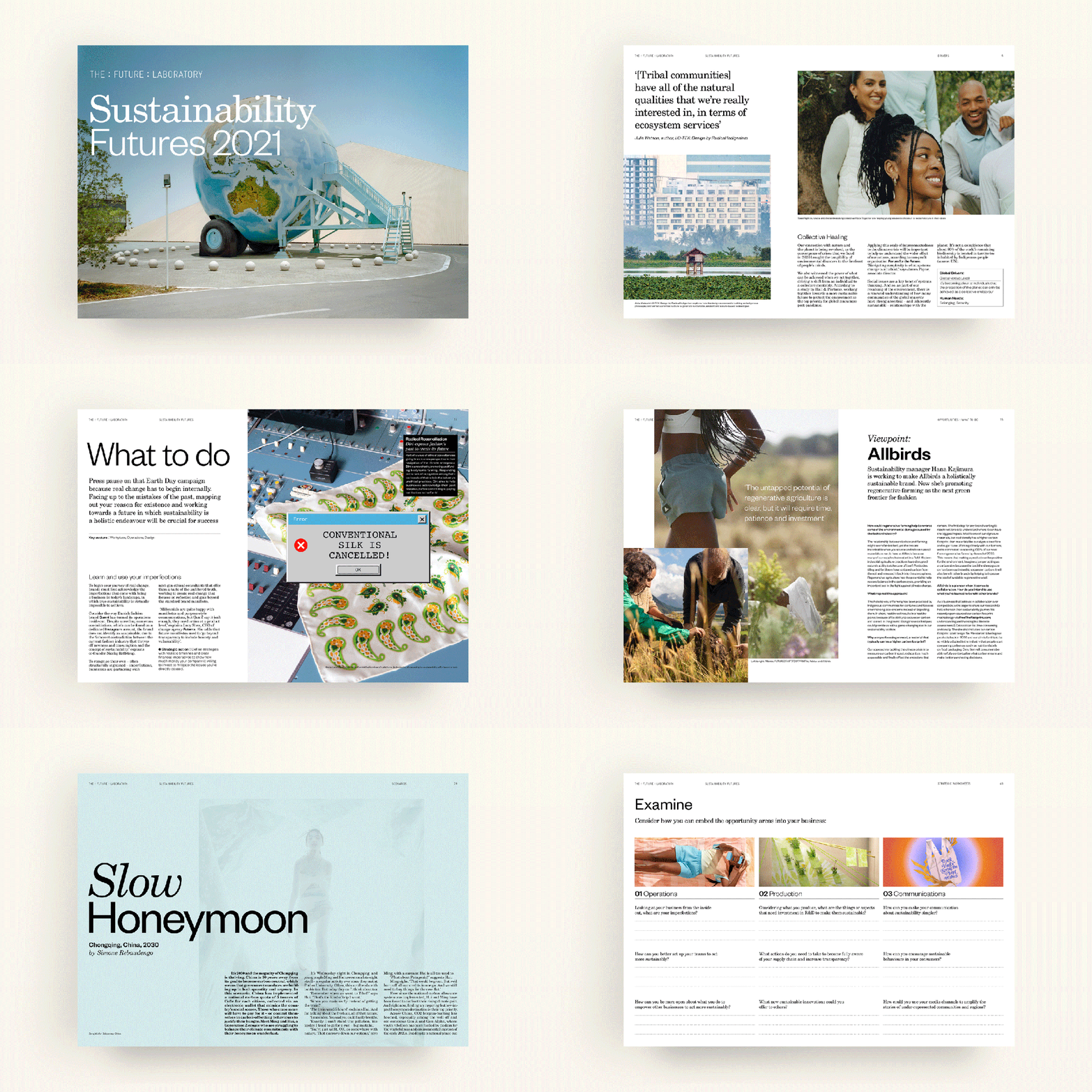
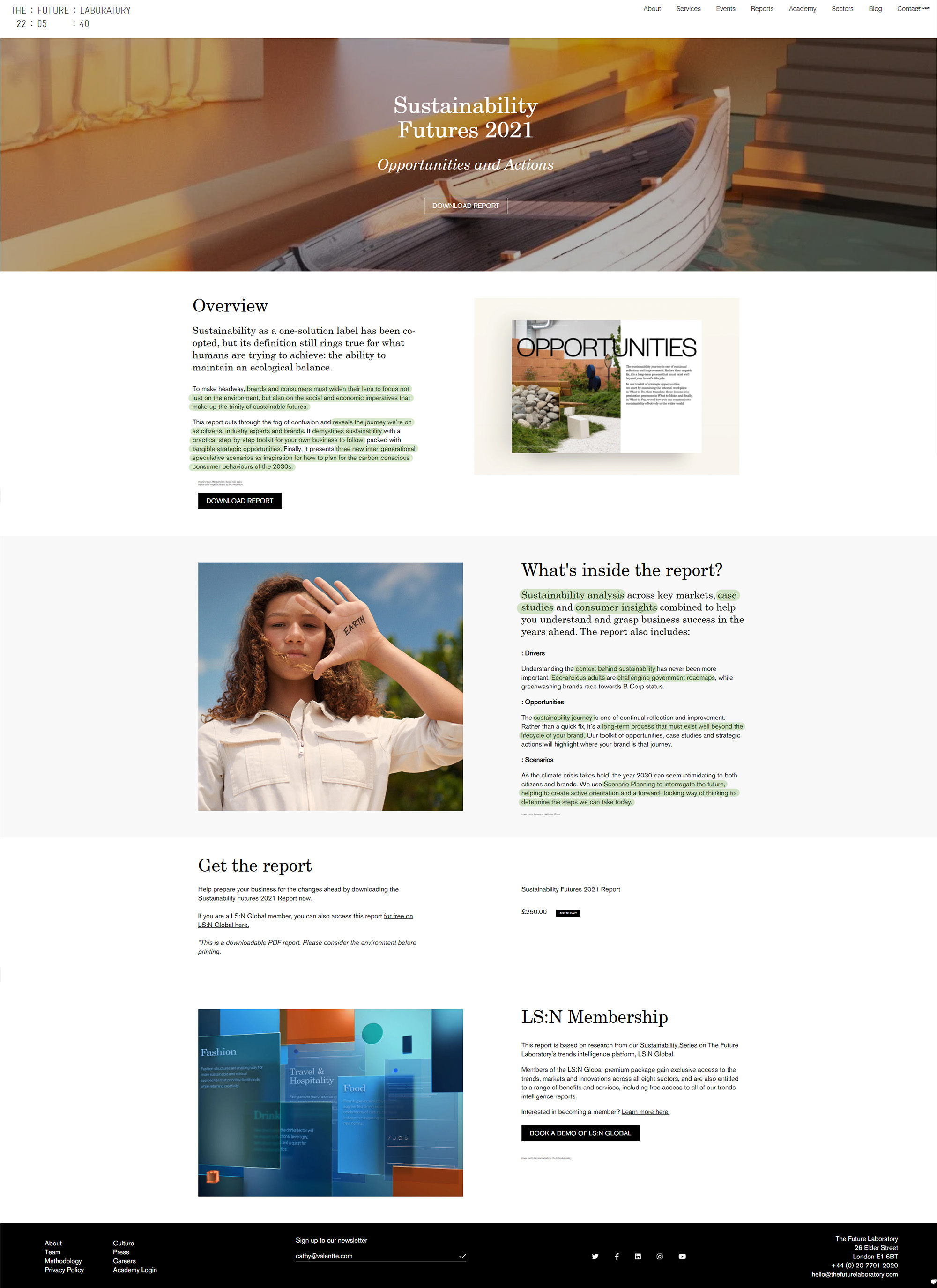
The Future Laboratory
https://www.thefuturelaboratory.com/


Workshop Challenge
Future Forecast 2021
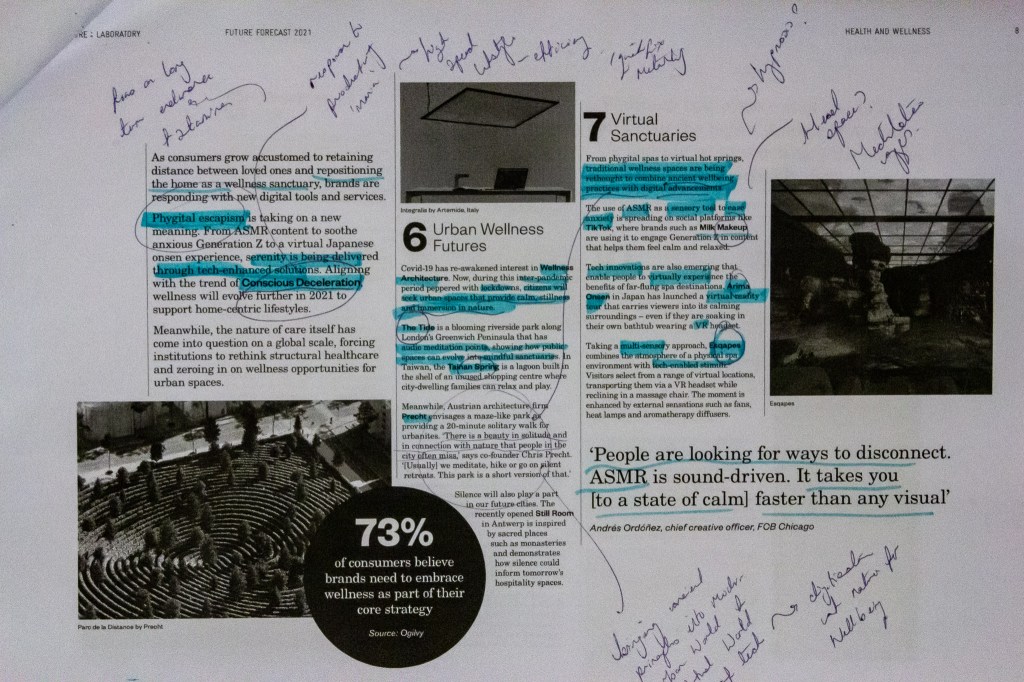

Virtual Sanctuaries
From phygital spas to virtual hot springs, traditional wellness spaces are being rethought to combine ancient wellbeing practices with digital advancements. The use of ASMR as a sensory tool to ease anxiety is spreading on social platforms like TikTok, where brands such as Milk Makeup are using it to engage Generation Z in content that helps them feel calm and relaxed. Tech innovations are also emerging that enable people to virtually experience the benefits of far-flung spa destinations. Arima Onsen in Japan has launched a virtual reality tour that carries viewers into its calming surroundings – even if they are soaking in their own bathtub wearing a VR headset. Taking a multi-sensory approach, Esqapes combines the atmosphere of a physical spa environment with tech-enabled stimuli. Visitors select from a range of virtual locations, transporting them via a VR headset while reclining in a massage chair. The moment is enhanced by external sensations such as fans, heat lamps and aromatherapy diffusers.
Urban Wellness Architecture
Covid-19 has re-awakened interest in Wellness Architecture. Now, during this inter-pandemic period peppered with lockdowns, citizens will seek urban spaces that provide calm, stillness and immersion in nature. The Tide is a blooming riverside park along London’s Greenwich Peninsula that has audio meditation points, showing how public spaces can evolve into mindful sanctuaries. In Taiwan, the Tainan Spring is a lagoon built in the shell of an unused shopping centre where city dwelling families can relax and play. Meanwhile, Austrian architecture firm Precht envisages a maze like park as providing a 20-minute solitary walk for urbanites. ‘There is a beauty in solitude and in connection with nature that people in the city often miss,’ says co-founder Chris Precht. ‘[Usually] we meditate, hike or go on silent retreats. This park is a short version of that.’ Silence will also play a part in our future cities. The recently opened Still Room in Antwerp is inspired by sacred places such as monasteries and demonstrates how silence could inform tomorrow’s hospitality spaces.
Conscious Deceleration
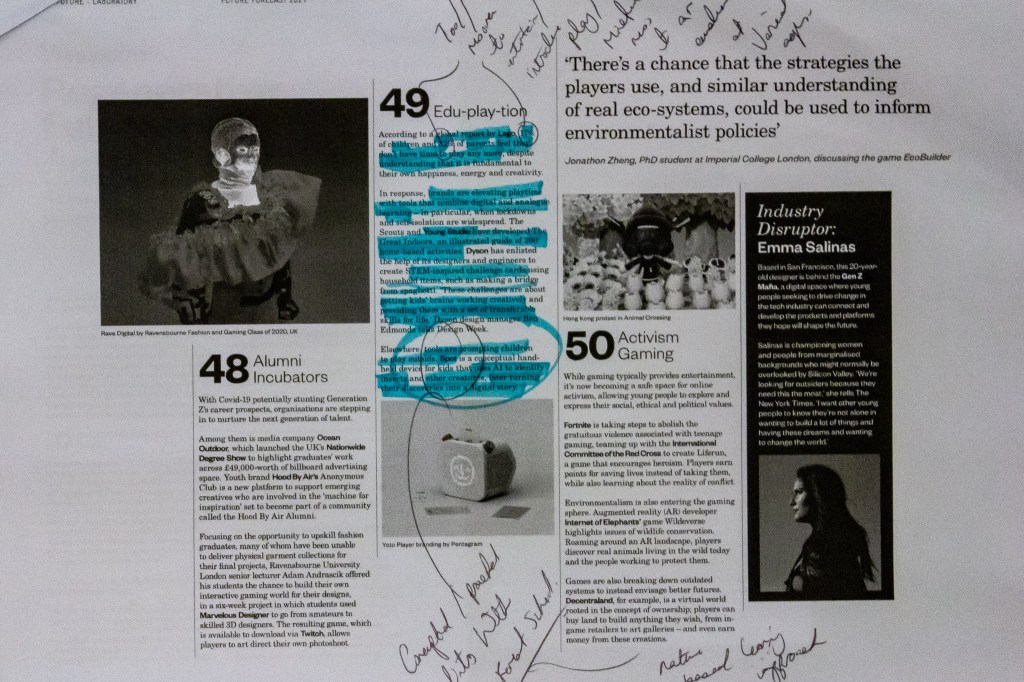
Edu-play-tion
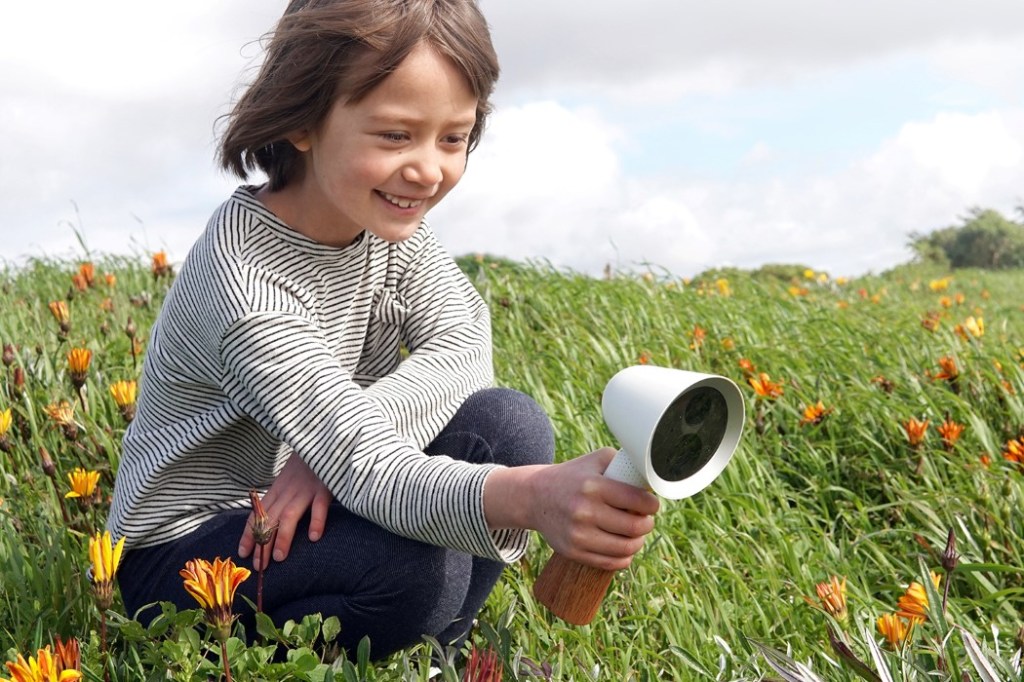
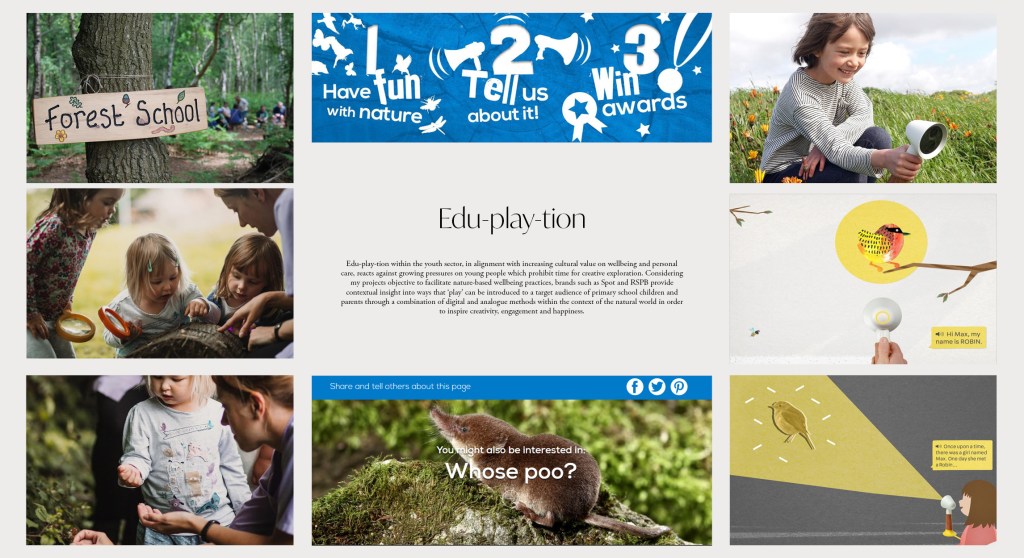
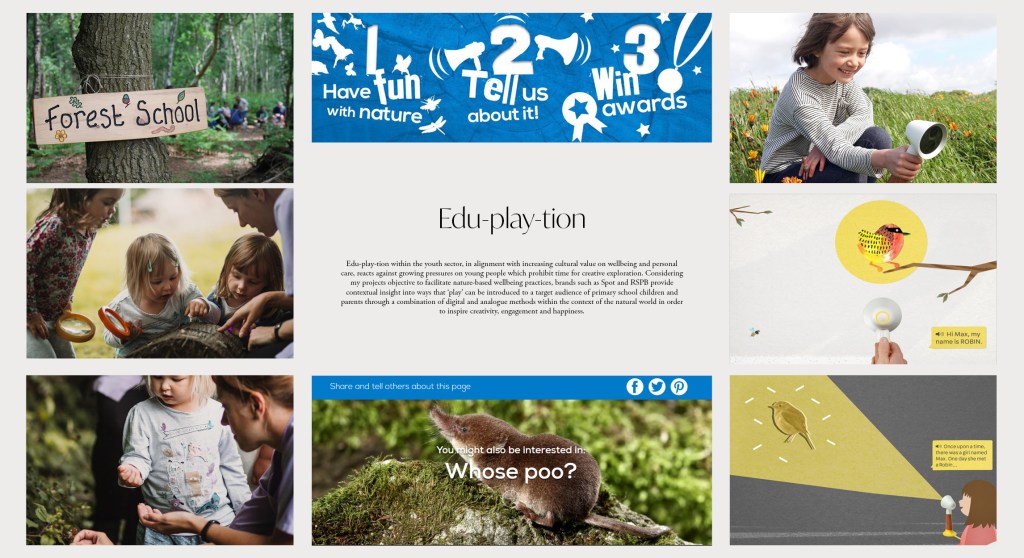
According to a global report by Lego, 17% of children and 32% of parents feel they don’t have time to play any more, despite understanding that it is fundamental to their own happiness, energy and creativity. In response, brands are elevating playtime with tools that combine digital and analogue learning – in particular, when lockdowns and self-isolation are widespread. The Scouts and Young Studio have developed The Great Indoors, an illustrated guide of 200 home-based activities. Dyson has enlisted the help of its designers and engineers to create STEM-inspired challenge cards using household items, such as making a bridge from spaghetti. ‘These challenges are about getting kids’ brains working creatively and providing them with a set of transferable skills for life,’ Dyson design manager Ben Edmonds tells Design Week. Elsewhere, tools are prompting children to play outside. Spot is a conceptual handheld device for kids that uses AI to identify insects and other creatures, later turning their discoveries into a digital story.
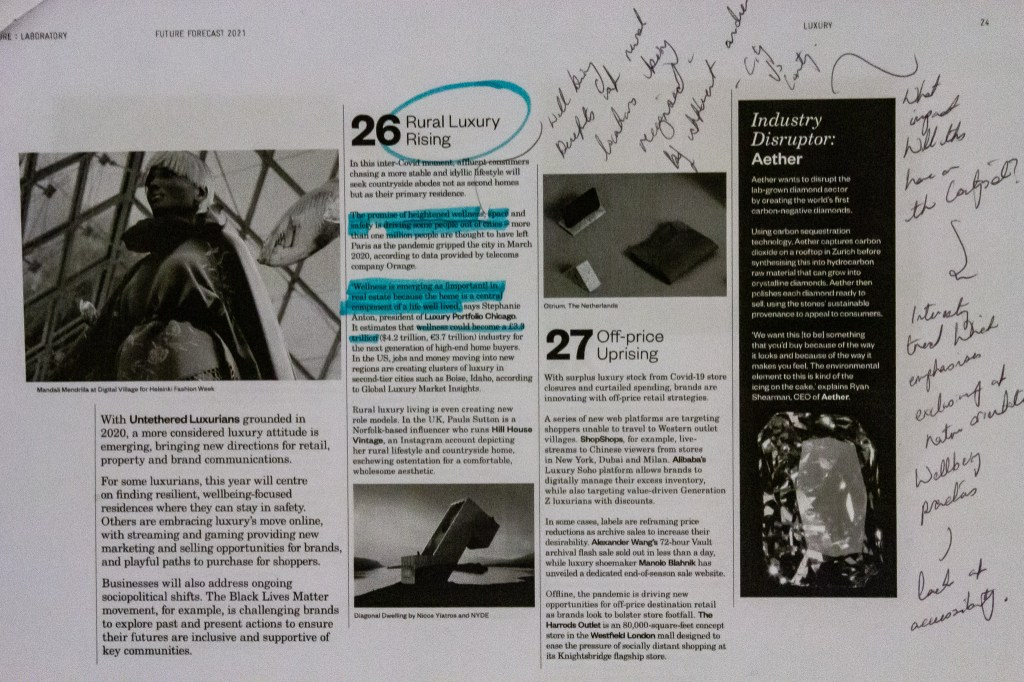
Rural Luxury Rising
In this inter-Covid moment, affluent consumers chasing a more stable and idyllic lifestyle will seek countryside abodes not as second homes but as their primary residence. The promise of heightened wellness, space and safety is driving some people out of cities – more than one million people are thought to have left Paris as the pandemic gripped the city in March 2020, according to data provided by telecoms company Orange. ‘Wellness is emerging as [important] in real estate because the home is a central component of a life well lived,’ says Stephanie Anton, president of Luxury Portfolio Chicago. It estimates that wellness could become a £3.3 trillion ($4.2 trillion, €3.7 trillion) industry for the next generation of high-end home buyers. In the US, jobs and money moving into new regions are creating clusters of luxury in second-tier cities such as Boise, Idaho, according to Global Luxury Market Insights. Rural luxury living is even creating new role models. In the UK, Paula Sutton is a Norfolk-based influencer who runs Hill House Vintage, an Instagram account depicting her rural lifestyle and countryside home, eschewing ostentation for a comfortable, wholesome aesthetic.
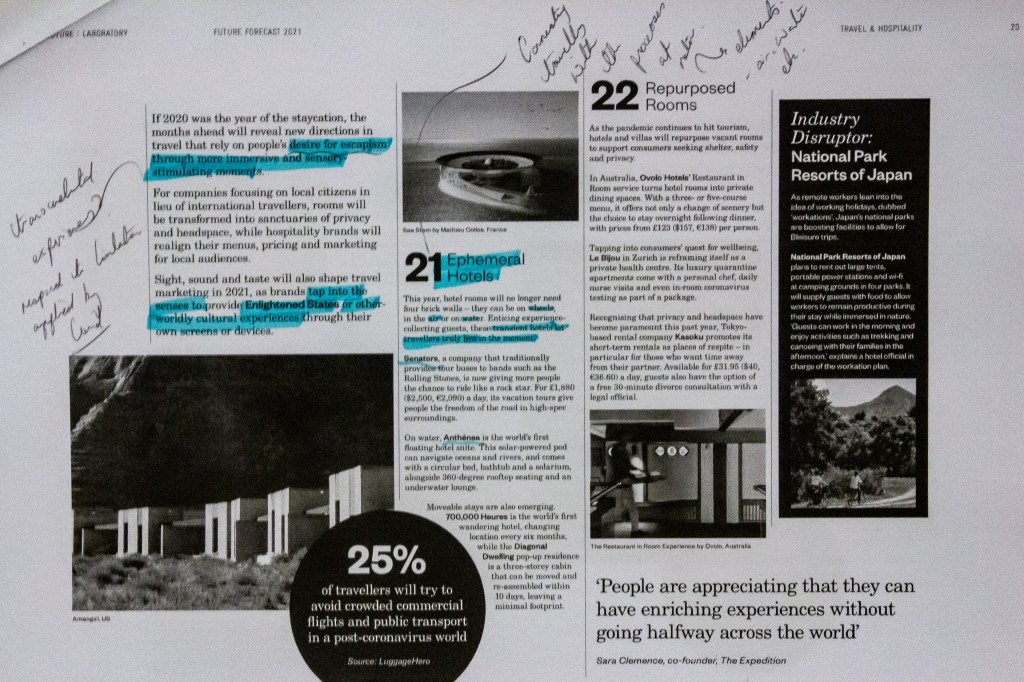
Ephemeral Hotels
This year, hotel rooms will no longer need four brick walls – they can be on wheels, in the air or on water. Enticing experience collecting guests, these transient hotels let travellers truly live in the moment. Senators, a company that traditionally provides tour buses to bands such as the Rolling Stones, is now giving more people the chance to ride like a rock star. For £1,880 ($2,500, €2,090) a day, its vacation tours give people the freedom of the road in high-spec surroundings. On water, nthénea is the world’s first floating hotel suite. This solar-powered pod can navigate oceans and rivers, and comes with a circular bed, bathtub and a solarium, alongside 360-degree rooftop seating and an underwater lounge. Moveable stays are also emerging. 700,000 Heures is the world’s first wandering hotel, changing location every six months, while the Diagonal Dwelling pop-up residence is a three-storey cabin that can be moved and re-assembled within 10 days, leaving a minimal footprint.
Sensory Destinations
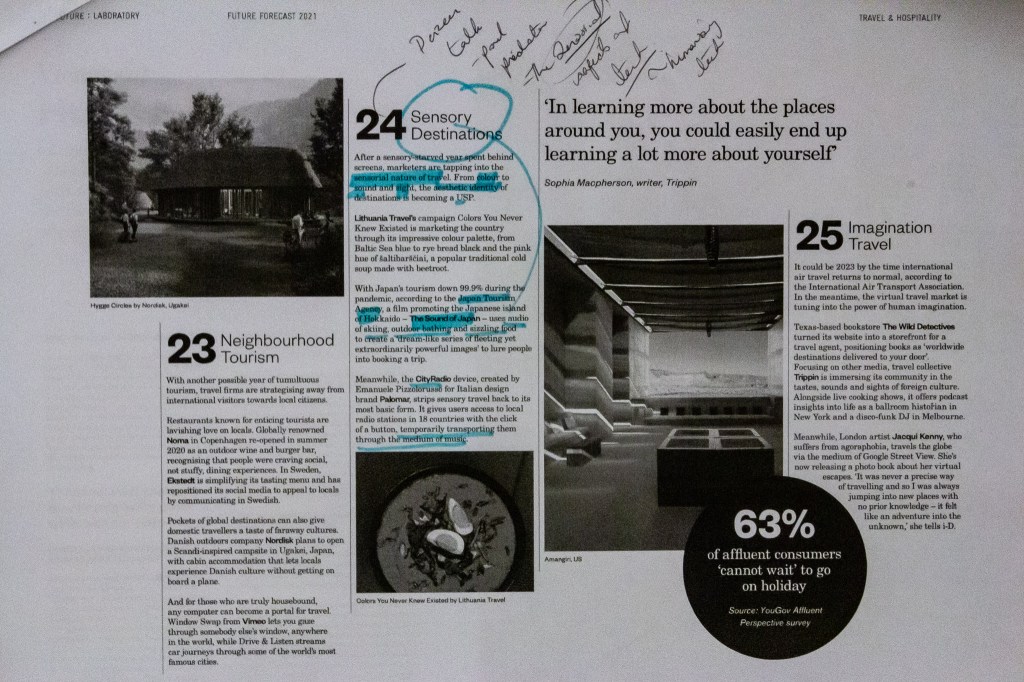
After a sensory-starved year spent behind screens, marketers are tapping into the sensorial nature of travel. From colour to sound and sight, the aesthetic identity of destinations is becoming a USP. Lithuania Travel’s campaign Colors You Never Knew Existed is marketing the country through its impressive colour palette, from Baltic Sea blue to rye bread black and the pink hue of šaltibarščiai, a popular traditional cold soup made with beetroot. With Japan’s tourism down 99.9% during the pandemic, according to the Japan Tourism Agency, a film promoting the Japanese island of Hokkaido – The Sound of Japan – uses audio of skiing, outdoor bathing and sizzling food to create a ‘dream-like series of fleeting yet extraordinarily powerful images’ to lure people into booking a trip. Meanwhile, the CityRadio device, created by Emanuele Pizzolorusso for Italian design brand Palomar, strips sensory travel back to its most basic form. It gives users access to local radio stations in 18 countries with the click of a button, temporarily transporting them through the medium of music.
Five Workplace Culture Trends of 2021
- eco anxiety
- biophilic design
- ethically conscious consumerism
- sustainable design
- wellbeing.
- Virtual Wellness
Mission Statement
My project goal is to introduce the wellbeing benefits of nature into the daily rituals of contemporary consumers in order to foster an appreciation of sustainability and environmentally beneficial practices. With a target audience ranging from younger children to climate aware adults vulnerable to eco-anxiety, I will analyse trends with specific reference to the psychological influences of natural engagement. As the target audience also includes individuals with limited access and experience of nature based activity, I will explore space and time efficient practical outcomes and concepts that accommodate the busy lifestyles of full time professionals and students.
For instance, Edu-play-tion incorporates the wellbeing benefits of nature based experiences into educational practices, either at home or in public education. Additionally, the trend in virtual sanctuaries digitises spa like or nature inspired meditation/ mindfulness/ relaxation exercises, democratising this form of wellbeing to the large majority of consumers with smart phones. Urban wellness architecture, in alignment with the principles of biophilic design, also provides opportunities to weave physical or digital experiences of nature into the built environment, disrupting the traditional way that users navigate urban spaces.
Considering these trends, I will consider innovative directions which educate and inspire positive environmental action in order to foster a deeper sense of connection with the natural world and a sense of agency in response to the uncertainty of the climate emergency.


- Select one mood board and upload it to the Ideas Wall to gain feedback and record the feedback on your blog.

Peer and Professional Feedback.
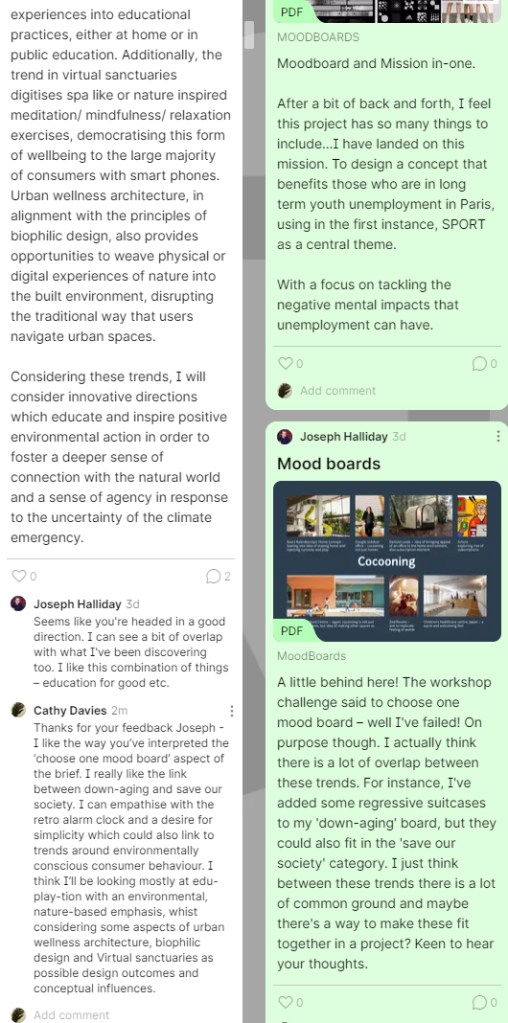
After discussion with Joseph on the ideas wall regarding culturally significant trends and their conceptual crossovers within our projects, I chose to focus on the trend in Edu-play-tion in order to explore how nature can be utilised for wellbeing within an educational context, whilst considering some aspects of urban wellness architecture, biophilic design and virtual sanctuaries for conceptual inspiration where relevant.
Having discussed this trend and its application within disciplines and initiatives such as forest school and outdoor education, my partner Ian Prior (Trainee Primary Teacher and Freelance Outdoor Education Instructor) recognised that primary school children receive the majority of these services and that it would be interesting to create a project which could target a wider age range of primary – younger adults and adults. Considering Josephs feedback, the crossover between trends is important to recognise going forward as the variety of design directions explored will inform how I approach an audience of, but not limited to, young children with an additional audience category of parents, education leaders and adults also seeking a beneficial, nature inspired wellbeing product.
Chosen Mood board:

 CATHY DAVIES